
For social secs and society committees
The pub crawl app for students
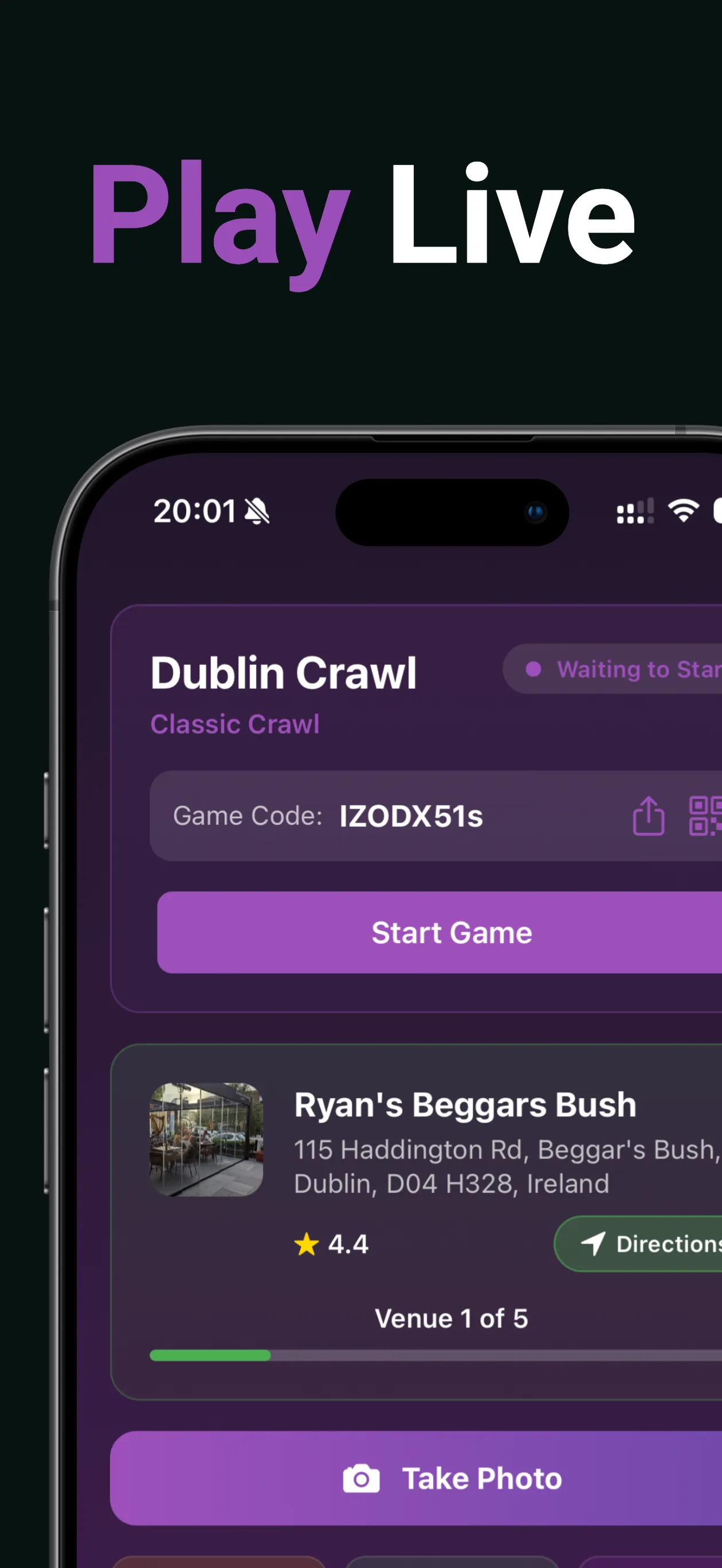
Plan the route once and everyone joins by scanning a QR code. Then, on the night, check in as you go so the group can see which pub everyone is actually in — which is the bit that matters in freshers week, when half the flat leaves the SU at different times.
See who is out, and which pub they are in
The hardest question in freshers week is not which pubs to go to. It is where is everyone — asked in a group chat, at half nine, by four people who have just come out of the SU and cannot find the rest of the flat.
Check in when you get somewhere and your friends see which pub you are in. They check in, you see theirs. Being out lasts about three hours and every new check-in resets the clock, so a crawl keeps you visible all evening without anyone thinking about it. Heading home on your profile stops it the moment you want it to.
A check-in can also be a post — the pub, the time, and a photo and caption if you want one. It goes to your friends, who can like it and reply underneath. It is the night as it happens rather than the forty photos somebody uploads three days later, and it is what makes a society's group actually feel like one across a night that has split into three pubs.
And if you do not know anyone out yet — which, in week one, is most people — the Out tab shows which pubs near you have people in them right now. That one names nobody: counts only, and a pub does not appear until at least three people are checked in.
Everyone joins by QR, so nobody gets lost
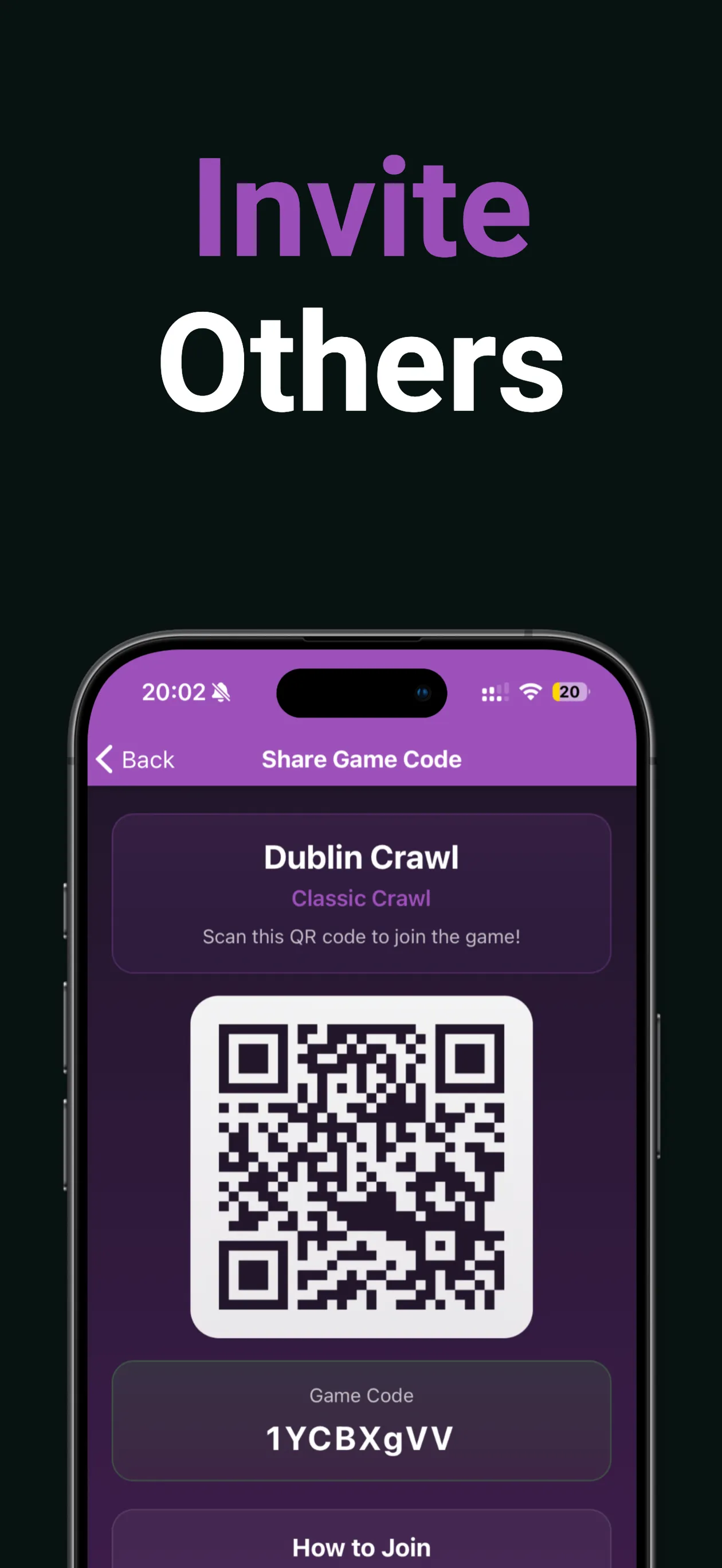
The normal way a student crawl is shared is a list of pub names pasted into a group chat, which is buried under sixty messages by nine o'clock. The organiser builds the route once and gets a join code and a QR code; everyone scans it and lands on the same crawl, same stops, same order, live on their own phone. Someone arriving at half nine opens the app and walks to the right pub instead of ringing you.
Two habits make it work. Send the join code before the night, with the meeting point and time, so people install the app at home rather than in a doorway with one bar of signal. And nominate a co-organiser who also knows the plan, because you will be at the bar when it is time to move.
What the app does
Before the night
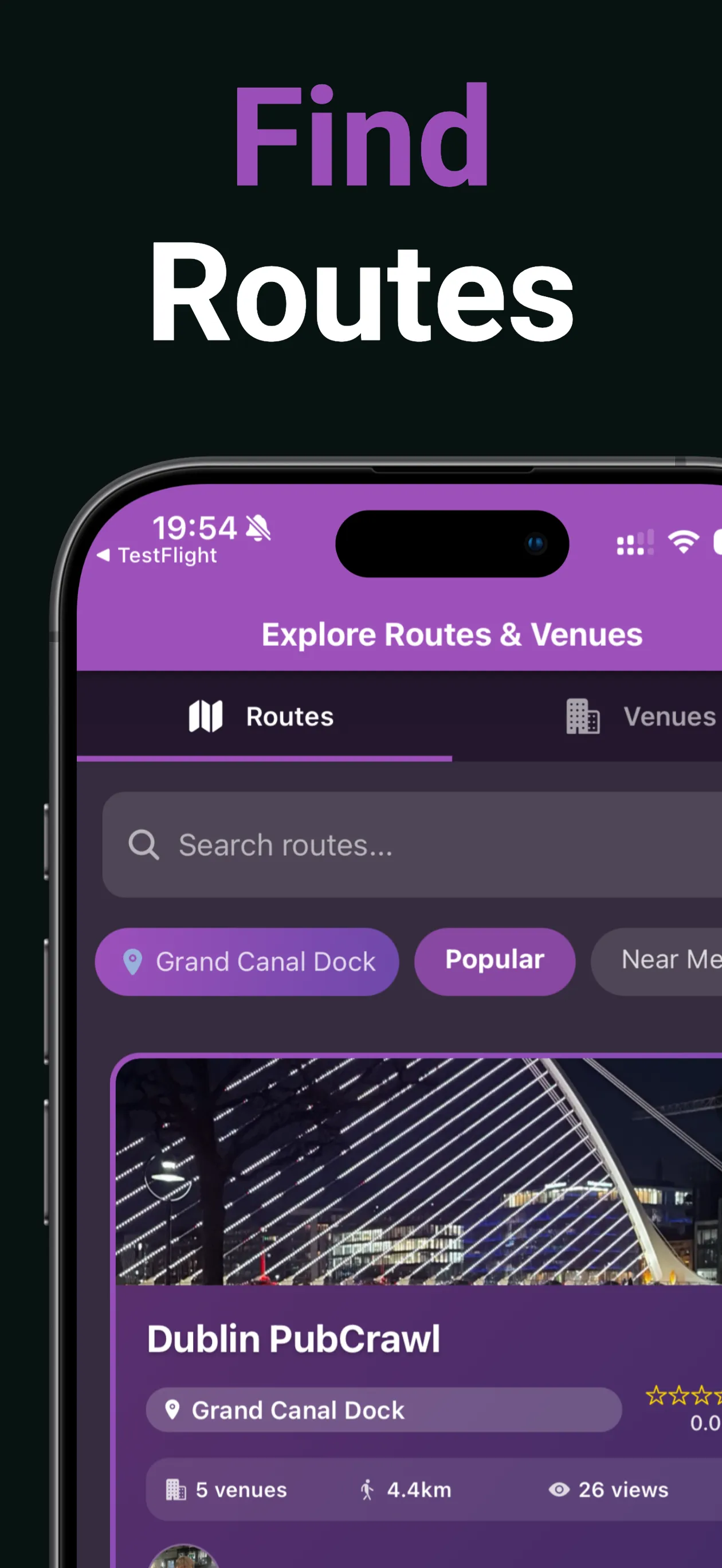
- Build a route or generate one. Hand-pick the pubs and run the optimiser for the shortest walk, or set a location, a stop count and how long you want the walks to be and let it build on real walking directions.
- Invite by QR or code. Everyone lands on the same crawl in the same order. Joining needs a free account.
On the night
- Check in, and be seen out. Friends see which pub you are in for about three hours after each check-in.
- Post it. A check-in with a photo and a caption, to your friends, with likes and replies.
- Find where is busy. Pubs near you with people in them right now — counts only, minimum three, no names.
- Skip a pub and swap in another. If a stop is shut or rammed, the host skips it and the app offers nearby venues to drop in instead.
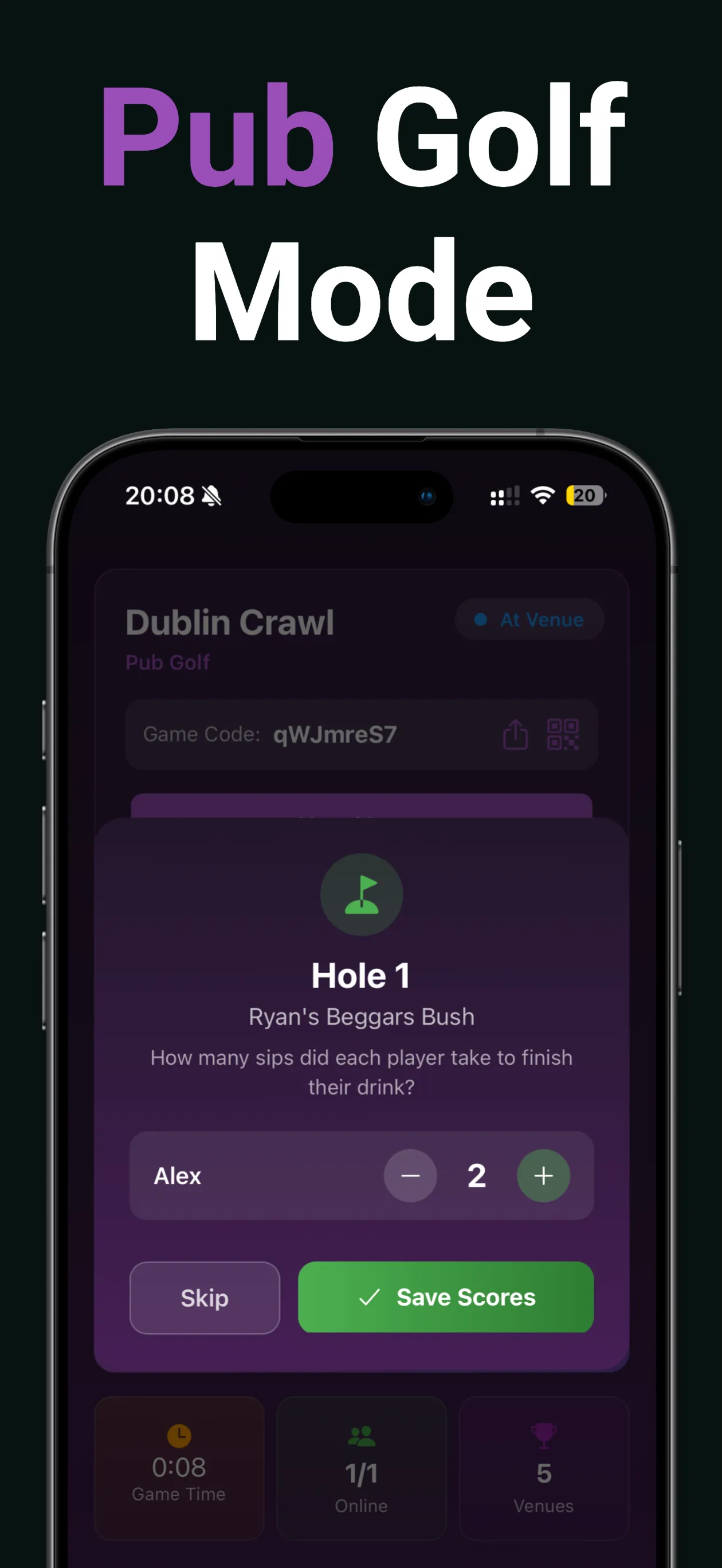
- Pub Golf and wheel games. Scorecards and a leaderboard when you want a game running.
Afterwards
- Photos stay with the crawl. Not one person's camera roll — one place everybody on the night can look through.
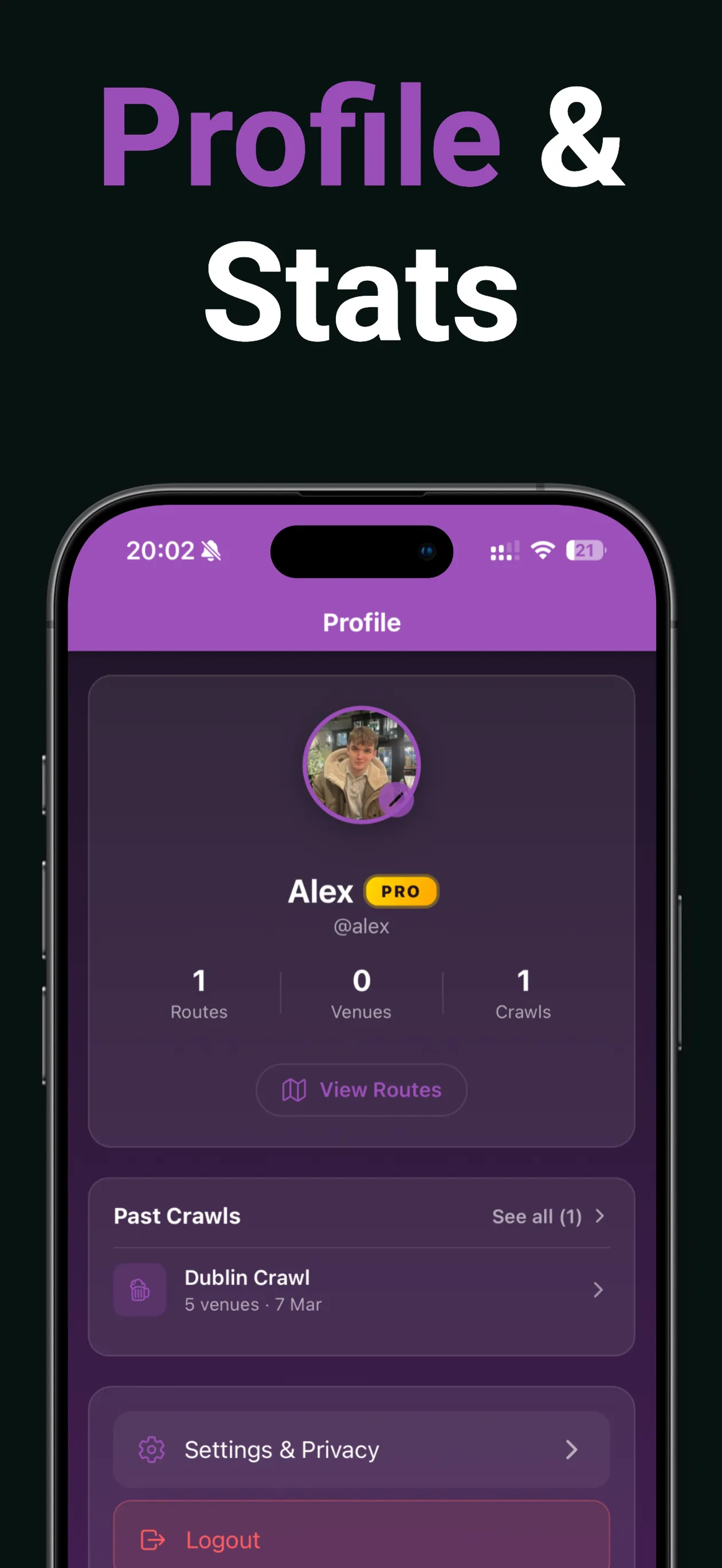
- A map of the pubs you have been to, with a count against your city, on your profile. Yours and your friends' eyes only.
Free covers routes of up to five stops, three saved routes, a crawl for up to eight people, check-ins, posts and photos that stay. A society crawl of fifteen to twenty needs the host on Premium — that lifts the group cap, takes routes to twelve stops, and unlocks Pub Golf and the Forfeit and Waterfall wheel games for everyone on that crawl. Nobody but the organiser pays.


Common questions
What happens if a pub says no to our group or is too busy to get in?
It will happen at least once on any crawl with fifteen or more people, so plan for it rather than hoping. In the app the host can skip the stop mid-crawl and pick a reason — closed, too busy, too empty, or could not find it — and the app then offers to search for venues near that spot and drop one straight into the crawl. Everyone else's phone updates to the new stop, so the route carries on instead of twenty people standing on a pavement arguing about where to go. Practically: put the biggest, most group-friendly pub first, get to the busier venues early because doors tighten on large groups later, and if you are turned away, move the whole group together rather than trying to filter in a few at a time.
How many pubs should a student pub crawl have?
Four to six. Allow about forty-five minutes per stop once you include walking, ordering and waiting for stragglers, so five pubs is roughly a four-hour night, and groups that plan eight or nine almost always lose people by the fourth. In the app a free route holds up to five stops, and Premium takes that to twelve — five is genuinely the right number for a first-year crawl anyway.
Can we do a crawl with more than 8 people?
Yes, but the host needs Premium. A crawl created by a free account is capped at eight players, and that cap is on the crawl rather than on each person, so for a society social of fifteen to twenty the organiser is the one who needs to upgrade and nobody else pays anything. The same applies to Pub Golf and to routes longer than five stops — it is all keyed to whoever is hosting.
Is PubCrawl free for students, and what actually costs money?
The free tier covers a real crawl: build or generate routes with up to five stops, keep up to three of your own routes, run a classic crawl for up to eight people, check in at every pub, take photos at each stop that stay afterwards, and use the Categories, No Names and Buy a Drink wheel games. Premium is what a big society crawl needs — groups over eight, up to twelve stops, unlimited routes, Pub Golf scoring, the Forfeit and Waterfall wheel games and no ads. Only the host pays, and only the host needs it for the whole group to get those things on that crawl.
How much should a student pub crawl cost per person?
Set the number before you publish the plan, because that is what decides who comes. In most UK cities a five-stop crawl where everyone buys their own drink lands somewhere between fifteen and thirty pounds a head depending on the city and what people are drinking. Say the figure up front, pick at least two stops that are genuinely cheap, and make clear that soft drinks are fine at any of them.
What is the best night to run a freshers pub crawl?
Midweek, usually Tuesday or Wednesday. Pubs are quieter so a group of twenty actually gets served, door staff are far more relaxed about large groups arriving together, and student nights and drinks deals cluster Monday to Wednesday. Saturday sounds right and is the hardest night to run a big group on.
Do we need to book the pubs in advance?
For fifteen people or more, tell them you are coming even if they will not take a formal booking. Phone rather than email, ask for the duty manager, and give the date, the arrival time and the headcount. Plenty of pubs will not reserve space for a drinks-only group at the weekend but will happily hold an area midweek, and a manager who is expecting you will put an extra person behind the bar.
Does the app work out the walking route between the pubs?
Yes. Generated routes are built on real walking directions rather than straight lines, and you set how long you want the walks between stops to be before it builds — five to fifteen minutes is the sensible range for a big group. Every route shows the distance and the walking time to the next venue, and if you hand-pick the pubs yourself you can run the optimiser to reorder them into the shortest walk.
How do I include people who are not drinking?
Design it in rather than apologising for it. Pick venues with proper alcohol-free options rather than one warm bottle of cola, make one round in the middle a soft round for everybody, and score any game on stops reached, check-in order or photos rather than on drinks. Nobody should have to explain why they are not drinking, and nobody should be bought a drink they did not ask for.
What happens to the photos afterwards?
Photos taken at each stop go to the crawl itself, not to one person's camera roll, so the whole night ends up in one place that everybody on it can look through and react to. They do not expire. For a society that is the honest reason to bother: the reel from this year's crawl is what fills next year's. Separately from the crawl, any check-in can be posted with a photo and a caption to your friends, who can like it and reply underneath.
Can we see which pub everyone is at?
Yes, and it is the part worth having in freshers week. Check in when you get somewhere and your friends see which pub you are in; they check in and you see theirs. It lasts about three hours and every new check-in resets the clock, so a crawl keeps you visible all evening without anybody thinking about it. This is what replaces the usual chain of “where are you” messages when half the flat leaves the SU at different times — you open the app rather than ring round. “Heading home” on your profile stops it immediately.
How do I find out where is actually busy tonight?
The Out tab shows which pubs near you have people in them right now, whether or not you know anyone there. It names nobody — it is counts only, and a pub does not appear at all until at least three people are checked in, because “one person here” in a small town on a Tuesday tells you exactly who that is.
Can people see where I am if I don't want them to?
No. Being shown as out is accepted friends only — not the public, and not someone who has merely asked to be your friend; you both have to have accepted. The map of pubs you have been to is likewise only ever visible to you and your friends. New accounts are private by default, and every existing account was moved to private too, so the starting position is the careful one and you opt out of it rather than into it. Settings → Privacy has the lot, with each toggle saying what it does.
Student crawls by city
Real pubs and real published routes, not a list of city names.